
Thermal Clad

Introduction / Benefits

Thermal Management Substrate, Im

Electronics of the future brings demanding new challenges that need innovative new answers.

Thermal Clad is one of these answers. It is a material that considers heat transfer as a design requirement.

As devices get smaller and power goes higher, electronics designers need to continually challenge traditional methods of design to develop more reliable product designs. Thermal Clad’s applications run from semiconductor modules to power supplies and motor controls.

WHY USE THERMAL CLAD?

THERMAL MANAGEMENT SUBSTRATE, IM
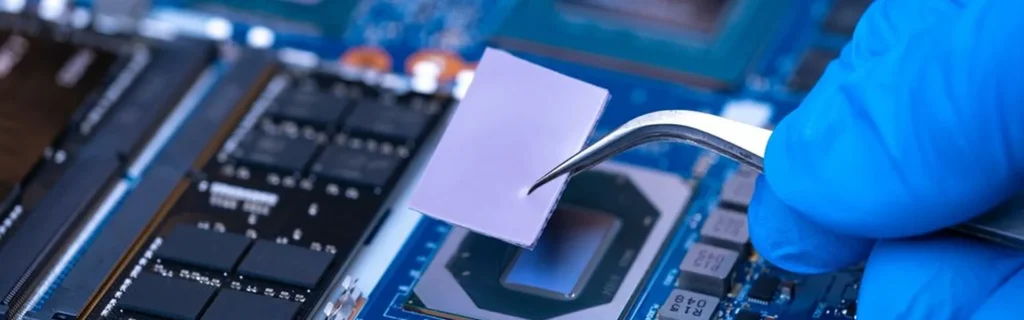
Thermal Clad is used as a substrate, heatsink and /or printed circuit material.

In the design phase, the engineer considering the use of Thermal Clad should evaluate the new design in light of the potential to:

LED Thermal Management

Light Emitting Diodes (LEDs) have been around for years, primarily concentrated in such markets as cell phones, PDAs and other consumer electronics. Since most of these products have relatively short lifecycles, protecting LEDs was not of primary concern because the product would fail or become obsolete long before the LED failed. Today, as technological advancement in LED design and processes are continually boosting light output to rival incandescent, florescent and even halogen light sources, the need to protect the lamps against heat build-up is greater than ever before.
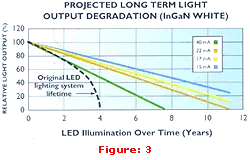
As is true for most electronic components, heat is the greatest threat to an LED. Not only can heat damage the electrical integrity of the LED, (eventually leading to lamp failure), it can also effect the light intensity and change the colour of the light output. The key to maintaining consistent, high-intensity output over an extended period of time is state-of-the-art thermal management materials such as T-Clad™ Insulated Metal Substrates (IMS®).

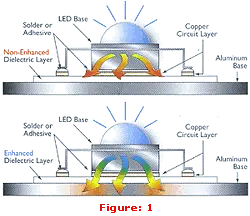
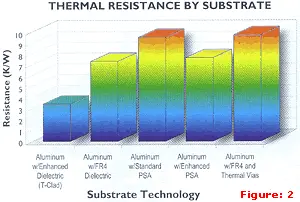
In a typical LED configuration (Figure 1), heat generated by the LRD lamp is transferred to the base metal through the dielectric layer. However, most dielectrics selected for this purpose have little or no thermal conductivity to move heat away from the assembly and into the heat spreader (the metal base). Often referred to as enhanced dielectric, T-Clad™ minimises thermal impedance and conducts heat more effectively and efficiently than standard printed circuit boards (see Figure 2).
Gap Pad® materials are highly conformable, thermally conductive interface pads designed to fill air gaps between heat-generating components and heat spreaders, helping improve cooling performance across multiple applications. Available in various thicknesses and custom shapes with or without adhesive, Gap Pads support consistent thermal management even when component heights differ.
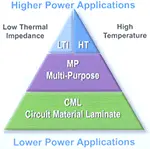
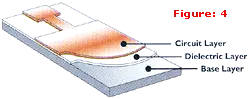
T-Clad™ insulated metal substrates are comprised of a circuit layer, a thermally enhanced dielectric layer and a metal substrate (see Figure 4). The key to T-Clad’s superior performance lies in its dielectric layer. This layer offers electrical isolation with high thermal conductivity and bonds the base metal and circuit foil together. Other manufacturers use reinforced fiberglass or pressure sensitive adhesive (PSA) as a dielectric layer, but none of them provide the high thermal conductivity and resulting thermal performance required to help assure the lowest possible operating temperatures and brightest light output for high-intensity LEDs.

SUPPORT FAQs

Common Questions About Our Products

How does the cost of Thermal Clad compare to those of FR4?
The simple answer is: it does not! To make a true and useful cost comparison, one should compare the cost of FR4 + heat sink + device mounting hardware (such as clip, screw or clamp) + interface (Sil-Pad) plus the cost of manual assembly versus the Thermal Clad automated surface mount assembly. Taking into consideration all relevant costs, Thermal Clad system is lower overall when comparing it to a traditional printed circuit board (PCB) and heat sink assembly.
Again the costs have to be like for like. Unlike Thermal Clad, Direct Bonded Copper (DBC) always involves some method of mechanically attaching it to a heat sink. This is either a solder operation or a mechanical frame to secure the DBC. It is not possible to secure the DBC with fixing holes built into the delicate ceramic whereas Thermal Clad can support fixing holes, rivets, pressed studs etc. In simple terms: Thermal Clad can be worked like any metal sheet, even forming into a box-shape is possible. Taking into consideration all relevant costs, Thermal Clad system provides lower overall costs when comparing it to a DBC substrate and heat sink assembly.
Yes, you can! Even if your company does not have the capability to assembly Thermal Clad, it is still possible to take advantage of Thermal Clad’s high thermal performance and also remove the need for a number of clips and screws per power device. Thermal Clad can be used to solder all of your power devices in a row and create a sub-assembly. The device leads are formed, then “through hole” mounted into your control PCB. Bergquist can offer names of sub-contract manufacturing assembly houses to build these assemblies. We call this system: Thermal Clad-Power Rail.
This depends on your application. For example in thermally demanding applications you will be concerned about transferring as much heat to the heat sink as possible. By assuming intermat contact between Thermal Clad and the heat sink you create the best possible heat path. Bergquist have a material designed to interface Thermal Clad to heat sinks called Hi-Flow 225FAC which is applied as a pad. It softens to a paste like consistency and wets the surfaces when it reaches a threshold temperature. In addition to this Thermal Clad can be formed with a bias so the part ends up convex. When bolted down with fixing holes around the edge, the part is assured intermat contact.
There is a need for both. Depending on your application, either copper or aluminium can be the best choice, since they both have their own specific advantages. Aluminium is a good choice for cost and thermal properties. But if your application demands heavy copper weight traces or tracks due to large currents or for mounting ceramic devices, then, as the copper thickness approaches 10% of the thickness of aluminium, the base material should be changed to copper. The use of a copper base for Thermal Clad is especially suitable when using naked devices or ceramic chip capacitors. Copper is closer to these components in thermal co-efficient of expansion which makes for more reliable solder joints. If you carefully select a thinner copper base versus the thicker aluminium base then the costs can be similar.
Any type of finish that can be applied to regular FR4 can be applied to Thermal Clad as well. This traditionally ranges from Hot Air Solder Levelling (HASL) for the reflow process and nickel-gold for Al wire bonding as an example. A solder mask is often used to keep parts clean and help with pattern recognition, it also contains the moulten solder during the re-flow process.
This is not required. In most cases if you design the solder pad area to mirror the exposed copper area of the back side of the device, the surface tension created in the molten solder during the re-flow process will bring badly aligned parts into the correct position.

You simply contact us. Bergquist can take care of all of your prototype needs. Obviously we can supply them ourselves, but we also have a network of local printed circuit shops familiar with processing Thermal Clad. They can supply prototypes on our behalf or you can work directly with them.
All you need to get started is:

  • Circuit pattern layout (preferably in electronic format i.e. Gerber)
  • Mechanical design giving:
  • positions for fixing holes and their size
  • overall dimensions and
  • importantly a dimension linking the artwork traces to a mechanical feature.
    (i.e. dimensions of fidusial to datum edges)
  • The material specification
  • The required finish will complete the information we need
The basic sizes ar: 609 x 457mm (24 x 18 inches) or 482 x 406mm (19 x 16 inches). Each panel has a border of 3.2mm (0.125 inches) which should be kept clear of active electrical tracks / traces. The border around the outside of the panel is normally used for tooling holes during the circuit processing of the material.
There is no simple answer to this one as each customer design will be different. As a general rule if your volumes are going to go above 5000 pieces then you might want to consider a punch tool. If the part has an irregular shape then punching or routing is normally used. If you design a rectangular part (i.e. no radii) then v-scoring offers good material utilisation.

Need More Help?

    Let’s Solve Your Thermal Challenges Together

    Get expert support for product selection, datasheets, and engineering guidance tailored to your application needs.